
Fashion commerce
Dan John: Online fitting room experience
A commerce experience concept that turns separate menswear categories into one guided outfit-building journey.
- Organization
- Dan John
- Technology
- Next.js / Medusa.js
- Live website
- Visit website
- Industry
- Fashion commerce
About the project
Explore how Dan John's broad menswear catalogue could support outfit building without forcing a shopper to compare every jacket, shirt, trouser, and shoe on a separate page.
Dan John sells across closely related menswear categories, including suits, jackets, shirts, trousers, knitwear, outerwear, shoes, and accessories. The public store also exposes a Mix & Match route, which confirms that coordinated purchasing is a meaningful part of the brand's real shopping model.
This study examines one specific opportunity within that model: keeping the complete outfit visible while the customer changes individual pieces. It is presented as an interaction and commerce concept, not as a claim that Lyzant rebuilt Dan John's production platform or delivered measured commercial results for the brand.
Research basis: Public catalogue review and supplied interface study.
The Challenge
A conventional fashion catalogue is organized around individual products. That structure works when a customer already knows the exact item they want, but it becomes inefficient when the intent is broader—for example, assembling a complete business or occasion look.
The customer must open several product pages, remember colours and silhouettes, check whether sizes remain available, and mentally judge whether the pieces work together. Each return to a category page removes some of the visual context created in the previous step. On smaller screens or in a large catalogue, that repeated back-and-forth makes comparison harder and increases the chance that the shopper abandons the outfit before reaching the bag.
The design challenge was therefore not simply to place products beside a model. It was to create a stable decision workspace where category, active selection, outfit preview, price, and the next purchasing action remain understandable at the same time.
The Process
- 01
Catalogue and journey review
The study began by reviewing the real category structure and the Mix & Match direction visible on Dan John's public storefront. The journey was mapped from outfit inspiration through category changes, product selection, size confirmation, and the final move toward purchase.
- 02
Information hierarchy
The interface was organized around three persistent layers: the model and current outfit, the category and product choices, and the purchase summary. This prevents product exploration from hiding the larger purpose of the session—building one coherent look.
- 03
Interaction design
Category switching, garment replacement, model switching, and outfit review were treated as related actions rather than separate pages. The design keeps the active choice visible and makes it clear which part of the outfit will change before a customer commits to a new item.
- 04
Scenario validation
The prototype was reviewed against practical scenarios: replacing only the jacket, moving between several categories without losing earlier selections, checking the completed look, and finding the purchase action without leaving the workspace.
The Solution
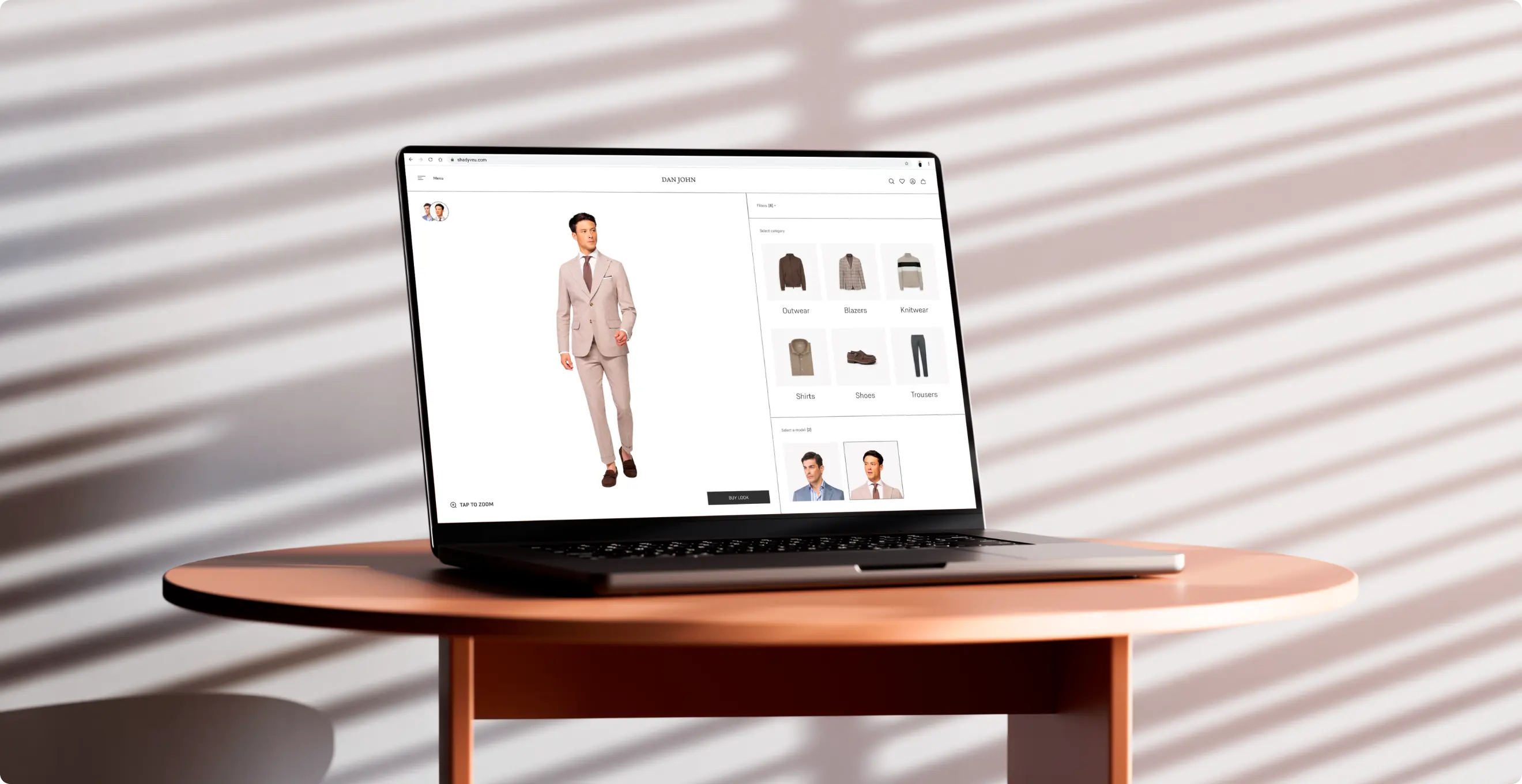
The proposed fitting room places the model at the centre of the experience and treats every product choice as part of the current outfit. A customer can move between outerwear, jackets, shirts, trousers, knitwear, and shoes while previously selected pieces remain visible.
The catalogue becomes contextual rather than disconnected. Selecting a category updates the available products; choosing an item updates the active look; and the purchase summary remains close enough to explain what has been selected. The interface can also carry essential commerce states such as size availability, variant selection, price changes, and an unavailable combination without breaking the visual flow.
For a production build, product, variant, inventory, price-list, region, and cart data would come from the commerce backend. The fitting-room layer would orchestrate those existing records into an outfit session rather than duplicating catalogue or inventory data in the storefront.
Interface walkthrough used to review hierarchy, interaction states, and the path from product discovery to purchase.
Platform Highlights
Persistent outfit state
Selections from several categories remain associated with the active look, so changing one garment does not erase the rest of the customer's work.
Variant-aware decisions
A production implementation can surface sizes, colours, availability, and regional pricing before the customer tries to add an incomplete or unavailable look to the bag.
Coordinated cart creation
The completed outfit can be translated into separate cart line items while preserving a single, understandable action for the customer.
Editorial entry points
Campaigns and curated looks can open the fitting room with a starting outfit already assembled, joining inspiration directly to product discovery.
What the concept validates
These practical questions define what a production prototype and usability test should prove before commercial results are claimed.
- Can a shopper replace one garment without losing the rest of the outfit?
- Is the active category, selected product, and resulting look clear at every step?
- Are size, availability, and price decisions introduced before the final purchase action?
- Can a curated look become a shoppable session rather than a static campaign image?
The Outcome
The resulting concept demonstrates a clearer route from outfit inspiration to a multi-item purchase. It gives the customer one place to understand how products relate instead of asking them to reconstruct that context across multiple browser tabs or product pages.
Because this is a concept study, no conversion uplift or revenue claim is presented. The credible outcome is the tested interaction model: a persistent outfit state, category-led replacement, visible purchasing context, and a structure that can be connected to real product, inventory, pricing, and cart services during implementation.
Business value of the proposed model
- Creates a natural path to discovering more than one product category
- Reduces the cognitive work required to compare a complete outfit
- Connects editorial styling with real catalogue and cart actions